Walk into a leather shop or browse wallets, belts and bags online, and you’ll quickly run into terms like PU leather, artificial leather, rexine, genuine leather and sometimes even “original leather.”
They may look similar in photos. They may even feel similar when they’re new. But they are not the same material.
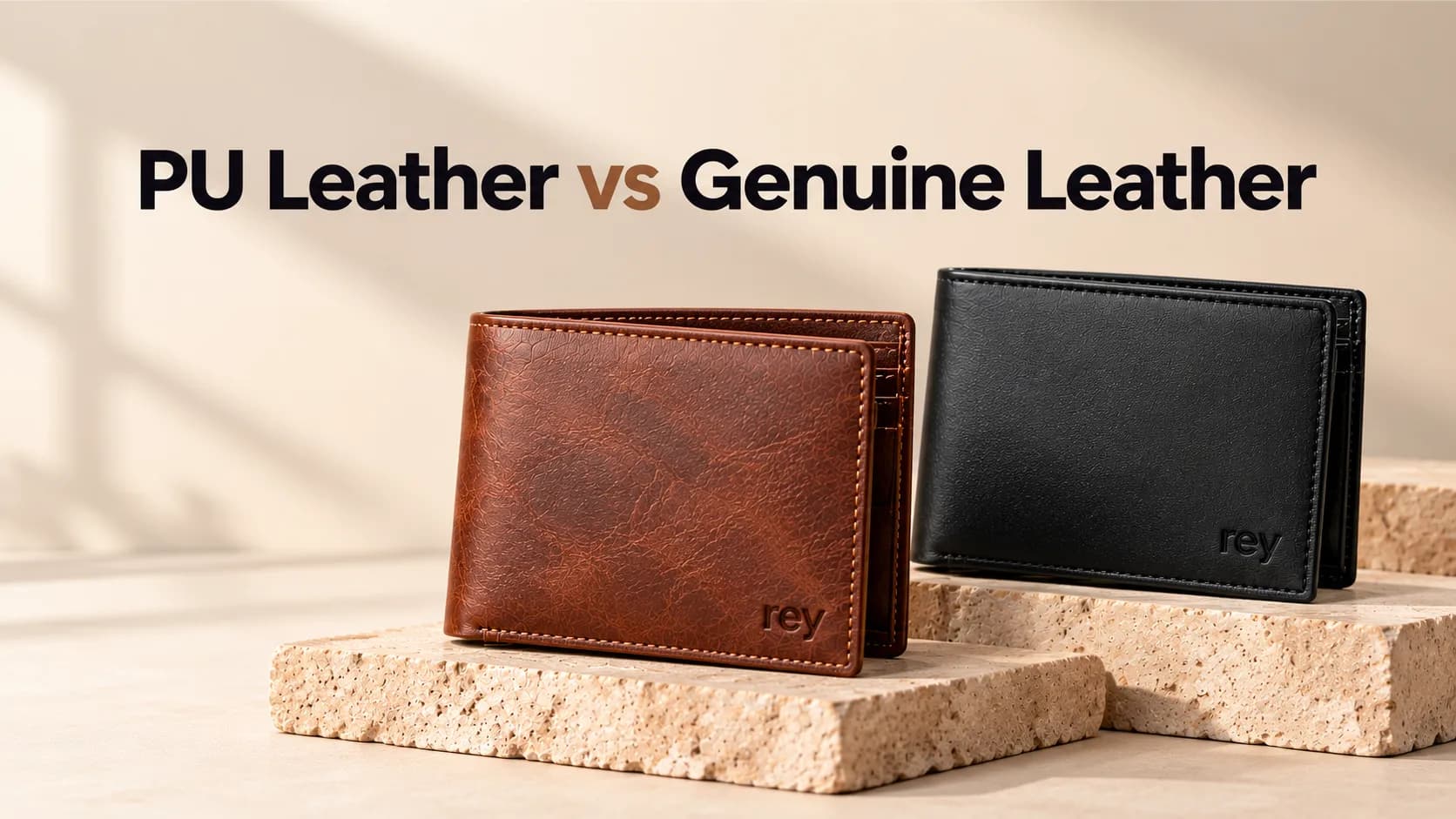
The biggest difference is simple: PU leather is a synthetic material made to look like leather, while genuine leather comes from real animal hide.
That difference affects how the product feels, how it handles everyday use, how it ages and, importantly, how long you can expect it to last.
If you’re trying to decide whether a wallet, belt, bag or pair of shoes is actually made from leather, this guide will show you what the common labels mean and what to check before you pay.
Quick Answer: PU Leather vs Genuine Leather
PU leather is generally a fabric base coated with polyurethane (PU), a type of plastic, and finished with a leather-like texture. Genuine leather is real animal hide that has been tanned and processed into a usable material.
Here’s the difference at a glance:
| PU Leather | Genuine Leather | |
|---|---|---|
| Made from | Fabric with polyurethane coating | Real animal hide |
| Feel | Usually smooth and uniform | Warmer, softer and naturally varied |
| Edges | May reveal fabric or layered backing | Usually dense and fibrous |
| Grain | Often very regular and repeated | Naturally irregular |
| Ageing | Coating may crack or peel | Can soften and develop patina |
| Price | Usually lower | Usually higher |
| Breathability | Low | Naturally more breathable |
The tricky part is that modern PU can look surprisingly convincing. So appearance alone isn’t enough.
What Is PU Leather? (PU Leather Meaning)
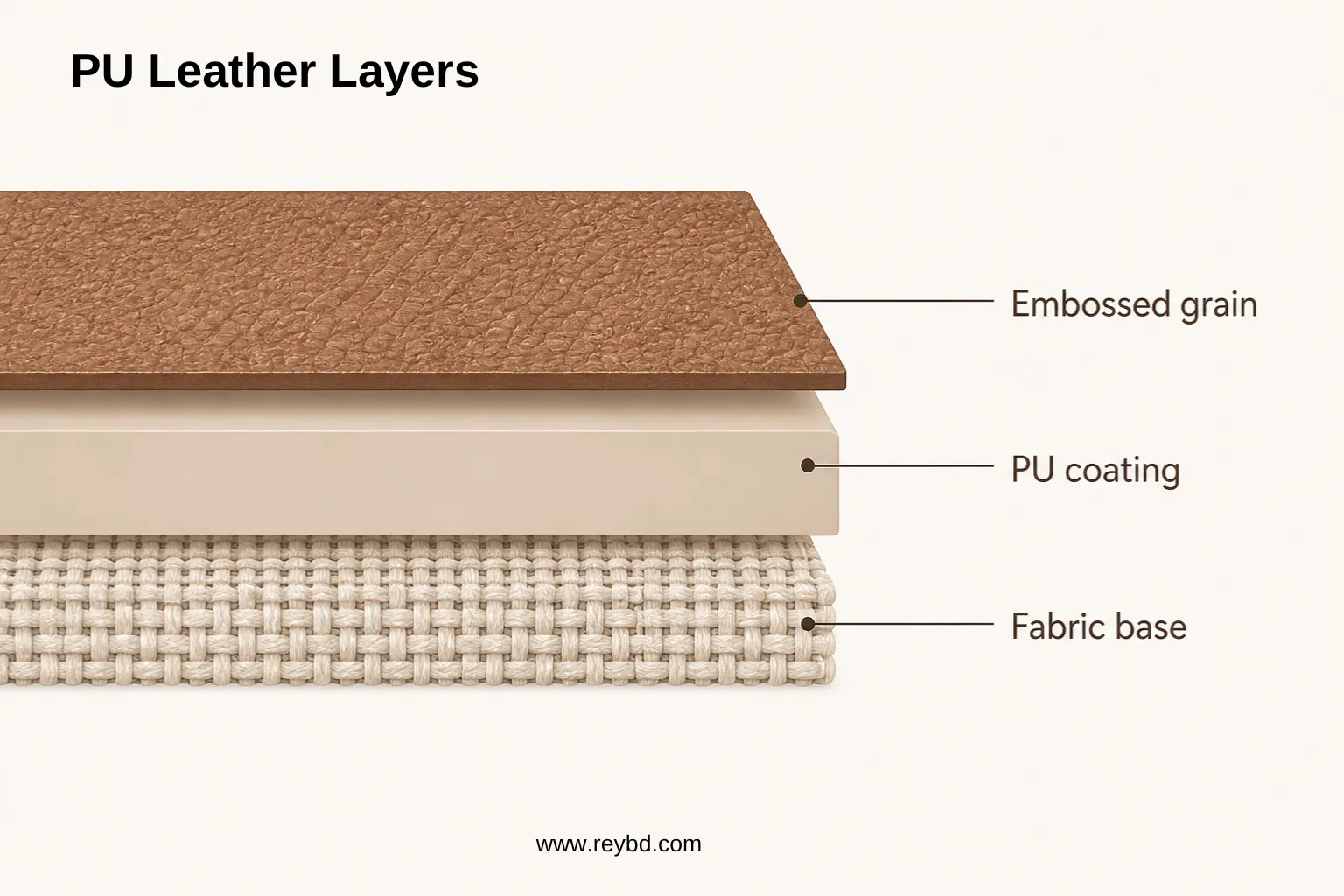
PU stands for polyurethane.
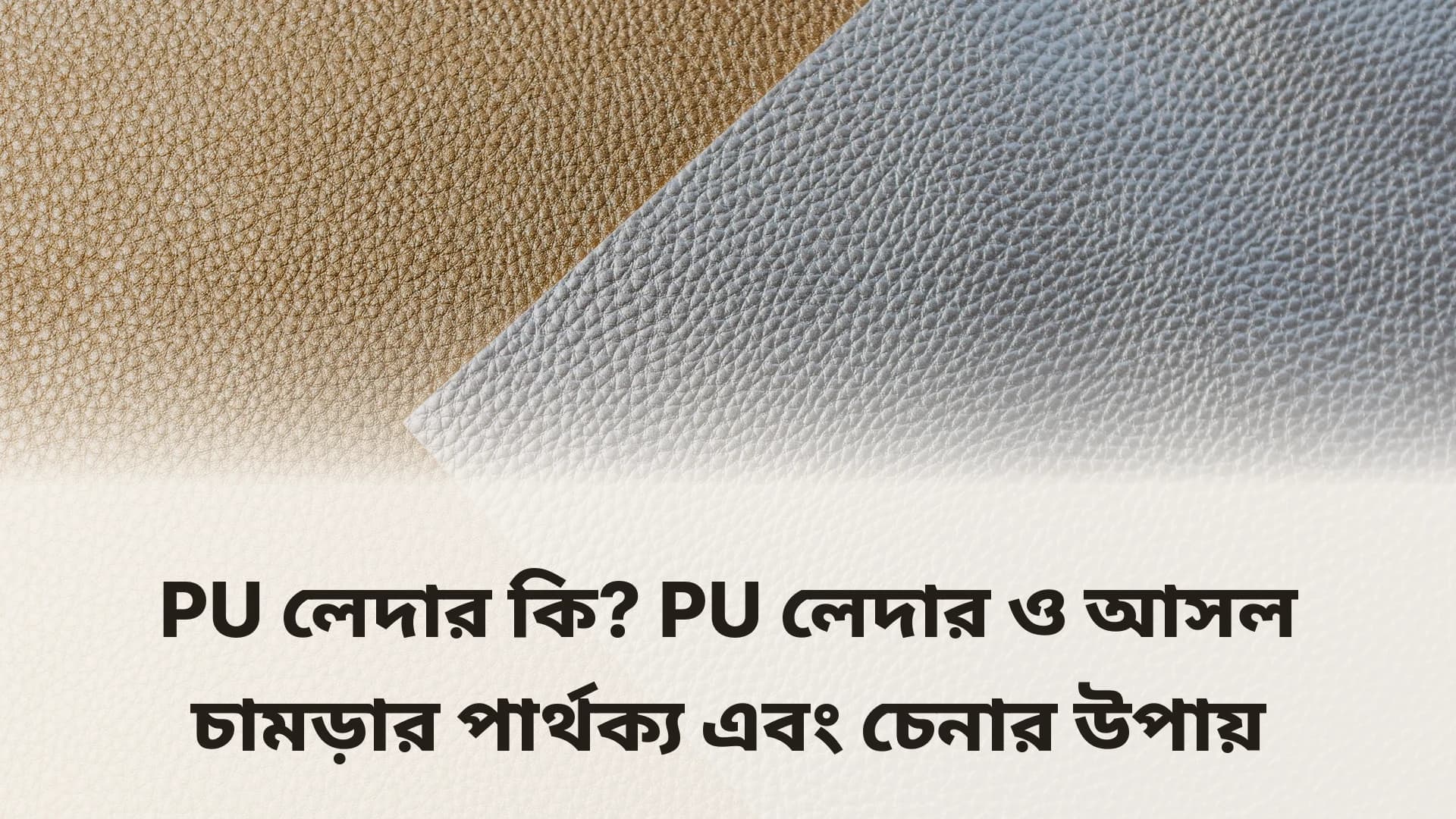
বাংলায়: PU লেদার মানে প্লাস্টিক (পলিইউরেথেন) কোটিং দেওয়া কাপড় — এটি আসল চামড়া নয়। বিস্তারিত বাংলায় পড়ুন: PU লেদার কি?
PU leather is one of the most common forms of faux leather, artificial leather or synthetic leather. Instead of being made from an animal hide, a base material is coated with polyurethane and given a surface pattern that resembles natural leather grain.
This is why a new PU wallet can look very similar to a leather wallet at first glance.
There are also two different materials that may be described using the PU label.
Pure PU leather
Pure PU is polyurethane applied over a fabric backing, commonly polyester or cotton.
There is no animal hide in the material itself.
Bicast or split PU leather
Bicast PU is different.
Here, polyurethane is applied over split leather—the lower fibrous portion of a hide after the upper layer has been separated.
That means there is real hide underneath, but the visible and touchable surface is still a polyurethane coating.
How is PU leather made?
The exact manufacturing process varies, but the basic idea is straightforward.
A polyurethane layer is formed with a leather-like grain pattern and bonded to a fabric or split-leather backing. The finished sheet can then be cut and stitched into wallets, belts, bags, furniture and other products.
Because the surface texture is manufactured rather than naturally formed, PU leather often has a very consistent grain.
Natural leather is rarely that perfect.
What Is Genuine Leather?
Genuine leather comes from real animal hide that has gone through tanning and finishing processes to make it durable, flexible and suitable for products.
Unlike PU, the surface began as skin. That means its pores, fibres, grain and small variations developed naturally.
Real leather also changes with use. Depending on the leather and finish, it may soften, darken and develop a patina rather than simply staying exactly as it looked when new.
There is one important complication, though.
“Genuine leather” doesn’t necessarily mean the highest grade
The word genuine confirms that a material is real leather, but it should not automatically be interpreted as “the best leather.”
Leather can be produced and finished in different ways.
Terms such as full-grain leather and top-grain leather describe other constructions or grades of real leather and can tell you more about what you’re buying than the word “genuine” by itself.
So if a seller simply says “100% genuine leather,” it is reasonable to ask:
What type of leather is it?
That question tells you much more.
Genuine leather also comes in different grades, from full grain to bonded. Our guide to the types of leather explains each grade, and our complete guide to leather covers how leather is made.
PU, PVC, Rexine, Faux Leather and Bonded Leather: What Do the Labels Mean?
Leather terminology can become confusing because shops and manufacturers don’t always use the same words.
Here is a practical way to understand the labels you are most likely to encounter:
| Label | What it usually means | Real leather? |
|---|---|---|
| PU leather | Polyurethane-coated material, usually with a fabric backing | No |
| Bicast / split PU | PU coating applied over split leather | Partly, but with a synthetic surface |
| PVC leather / rexine | Vinyl/PVC-coated fabric | No |
| Faux leather | General term for material made to imitate leather | No |
| Artificial leather | Another general term for synthetic leather | No |
| Synthetic leather | General category of manufactured leather alternatives | No |
| Microfiber leather | Synthetic microfiber base with a PU-type finish | No |
| Bonded leather | Leather fibres or scraps combined with binders and coatings | Contains leather material, but is not the same as a solid hide |
| Genuine leather | Real animal hide | Yes |
| Top-grain / full-grain leather | Types of real leather | Yes |
What about rexine?
In Bangladesh, rexine is a familiar name for leather-like synthetic material.
It can look convincing from a distance, particularly when it is new, but rexine and real leather are fundamentally different materials.
So when comparing rexine vs leather, don’t judge only by the grain printed on the surface. Look at the edges, backing and overall construction as well.
PU Leather vs Genuine Leather: Side-by-Side Comparison
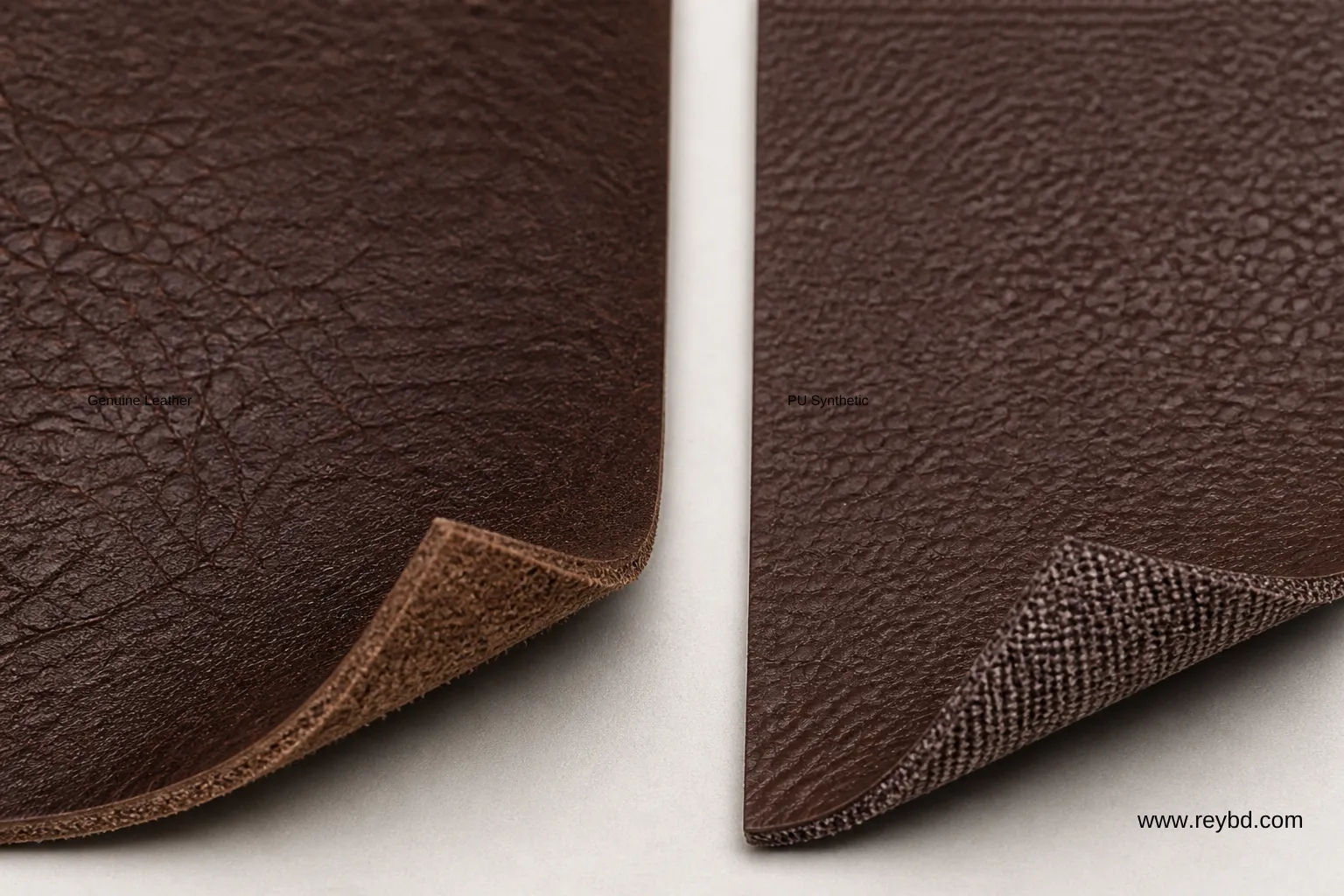
The difference becomes easier to understand once you look beyond appearance.
Feel
PU tends to have a smooth, consistent surface. Depending on its quality, it can sometimes feel slightly plastic.
Real leather normally feels warmer and has more natural variation from one area to another.
Grain
Synthetic grain is manufactured, so you may notice the same pattern repeating.
Natural leather grain is less predictable. Pores, wrinkles and small imperfections won’t normally repeat with machine-like consistency.
Breathability
A plastic-coated surface has limited breathability.
Natural leather is more breathable because of its fibrous structure, although coatings and finishes can affect this.
Water
PU generally resists small amounts of water at the surface.
Many natural leathers can absorb moisture, particularly if they are unfinished or lightly finished. That doesn’t mean leather should be deliberately soaked—proper care is still important.
Ageing
This is one of the most noticeable long-term differences.
As PU ages, its surface coating can eventually crack, flake or separate from the backing.
Real leather ages differently. With appropriate use and care, it can soften and develop changes in colour and character known as patina.
Repair
Once a synthetic coating begins peeling away from its backing, restoring the original surface is difficult.
Real leather can often be cleaned, conditioned or repaired depending on the type and extent of the damage.
Price
PU is generally cheaper to manufacture, so PU products usually cost less upfront.
Real leather generally costs more, although the final price also depends on leather quality, construction, hardware, workmanship and brand.
Why Does the Difference Matter in Bangladesh?
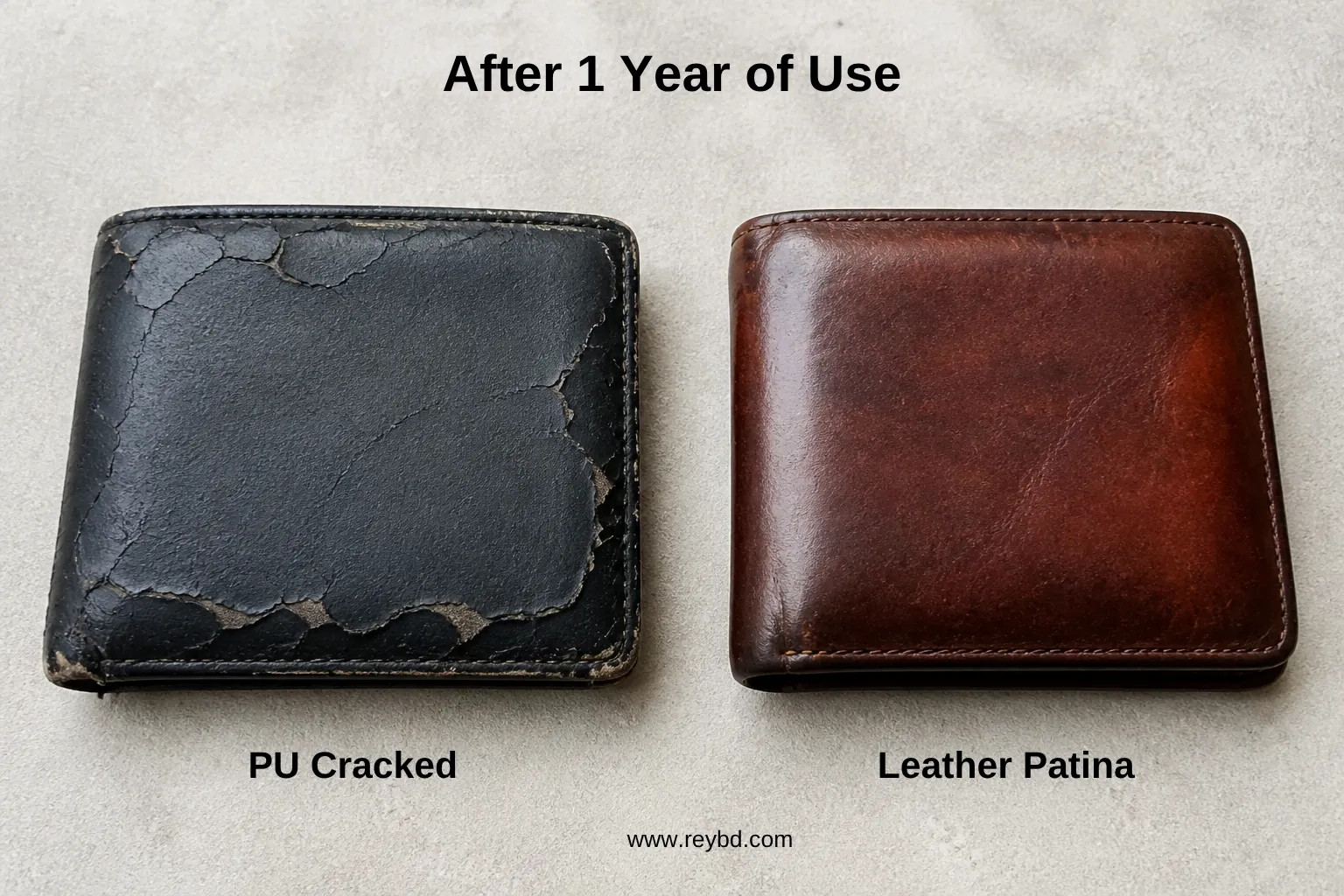
Material choice becomes particularly important when a wallet or belt is going to be used every day.
Bangladesh has long periods of warm, humid weather and a heavy monsoon season. Heat, moisture, sweat and repeated friction can all be demanding on materials.
A wallet carried in a back pocket, for example, experiences body heat, pressure, bending and moisture almost every day.
A belt goes through repeated flexing and may be exposed to sweat and humidity for hours at a time.
Synthetic coatings can deteriorate as they age, particularly when exposed to demanding conditions. Real leather avoids the characteristic peeling of a PU surface, although it has its own maintenance needs—especially moisture control and protection from mould during humid weather.
So the question isn’t simply:
“Which one looks better when it’s new?”
A better question is:
“How will this material look and perform after regular use?”
Real leather needs a little care in Bangladesh’s humid climate. Our leather care guide for Bangladesh explains how to prevent mould and protect it during the monsoon.
7 Ways to Tell PU Leather from Genuine Leather Before You Buy
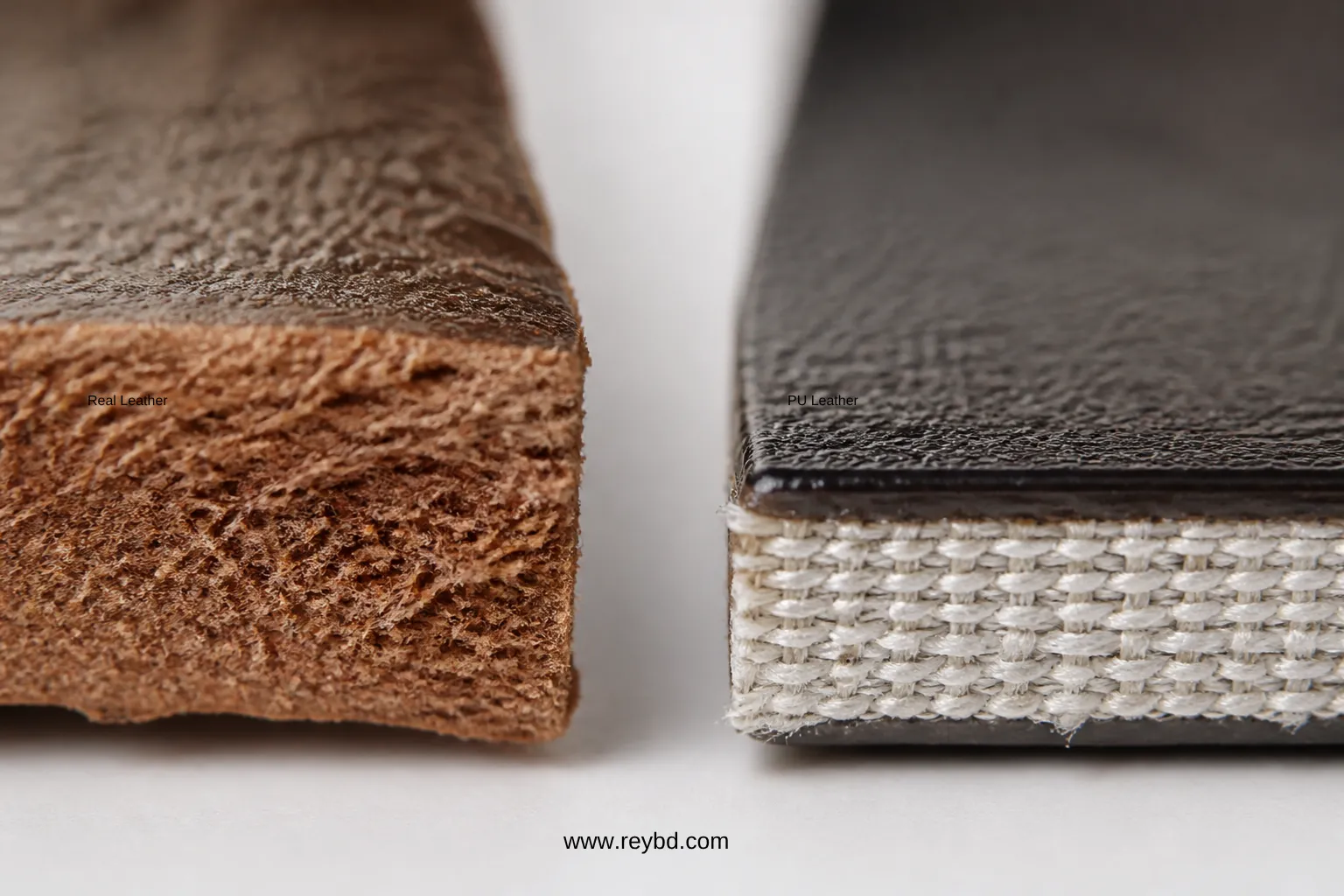
There isn’t one perfect test that works for every leather product.
Finishes, coatings and manufacturing techniques can make both real and synthetic materials harder to identify.
Instead, use several clues together.
1. Read the label carefully
Start with the obvious.
Terms such as PU, synthetic, man-made, faux, vegan leather, rexine or leatherette generally indicate that the surface is not natural leather.
If the listing only says “leather,” ask the seller exactly what type.
Don’t be afraid to ask a specific question:
“Is this real animal leather or PU/synthetic leather?”
A trustworthy seller should be able to answer clearly.
2. Look at the edges
Edges can reveal what a finished surface hides.
Real leather normally has a dense, fibrous structure at an exposed edge.
PU may show a thin surface coating with a separate fabric or foam-like backing underneath.
Some products have painted or sealed edges, so don’t stop there. Check an inner card slot, punched hole or another unfinished area if one is visible.
3. Check the back
If you can see the reverse side of the material, it can provide another strong clue.
Natural leather often has a fibrous, suede-like back.
Synthetic leather commonly reveals a woven or knitted fabric backing.
Wallet pockets and the reverse side of belts can be useful places to look.
4. Study the grain
Don’t just look for a “leather texture.” Manufacturers can emboss synthetic material with a very convincing grain.
Instead, look for repetition.
Real hide has natural variation. The pores, lines and small marks aren’t perfectly uniform.
PU can have a pattern that repeats because the texture was mechanically produced.
5. Press and bend the material
Press the surface gently with a finger and watch what happens around it.
Natural leather often forms small, irregular wrinkles around the pressure point.
Synthetic material tends to react more uniformly, although high-quality PU can make this test less obvious.
Again, treat it as one clue—not proof.
6. Use smell only as a supporting clue
Natural leather often has a distinctive earthy smell, while some synthetic products have a plastic or chemical smell.
But smell is unreliable on its own.
Manufacturers can add fragrances, while polish, packaging and other treatments can change or hide the natural smell.
Use it alongside the other checks.
7. Test water only when appropriate
A tiny drop of water on an inconspicuous area may behave differently on the two materials.
Some natural leather slowly absorbs moisture and darkens slightly. A synthetic coating is more likely to keep the water sitting on the surface.
But there’s an important exception: finished real leather can also repel water.
So a water droplet that beads up does not automatically mean the product is fake.
And never perform a water test on someone else’s product without permission.
What about the burn test?
Skip it.
Burning a wallet, belt or leather sample is unnecessary, unsafe and destructive. You can learn far more by combining the label, edge, backing, grain and feel checks.
For checks by product (wallets, belts, bags, shoes and jackets) and red flags when buying online, see our guide on how to identify real leather.
Is PU Leather Always a Bad Choice?
No.
Calling every PU product “bad” would be misleading.
PU and genuine leather serve different buyers and different purposes.
PU can be a reasonable choice when:
- you have a limited budget;
- you want a particular colour or fashion style;
- the item will only be used occasionally;
- easy surface cleaning matters to you; or
- you specifically want to avoid animal-derived materials and have confirmed that the product is pure PU rather than bicast leather.
The important thing is knowing what you’re buying and paying accordingly.
Problems arise when synthetic material is presented or priced as if it were genuine leather.
For something you expect to use heavily for years—such as an everyday wallet or belt—the material, construction and workmanship deserve closer attention.
Frequently Asked Questions
Is PU leather real leather?
Pure PU leather is not real leather. It is a synthetic material, typically made with a polyurethane surface over a fabric backing. Bicast PU is different because it uses split leather underneath the PU surface.
Does PU leather peel?
PU leather can peel as it ages because the polyurethane surface can eventually separate or break down. How quickly this happens depends on the quality of the material, how frequently it is used and the conditions in which it is stored and worn.
How long does PU leather last?
There is no single lifespan that applies to every PU product. Material quality, construction, frequency of use, heat, humidity, friction and storage conditions all affect durability. This is why it is better to evaluate the product itself rather than rely on a fixed number of years.
Is PU leather waterproof?
PU leather generally has a water-resistant surface, but that does not make every PU product completely waterproof. Water can still enter through seams, edges, stitching and damaged areas.
What is the difference between PU and PVC leather?
Both are synthetic alternatives designed to imitate leather, but they use different plastic coatings. PU uses polyurethane, while PVC synthetic leather uses polyvinyl chloride. Their softness, flexibility and performance can vary considerably depending on how each material is manufactured.
What is the difference between rexine and leather?
Rexine is a leather-like synthetic material, while leather is made from real animal hide. Rexine is generally cheaper and easy to wipe clean, but it does not have the same natural fibrous structure or ageing characteristics as genuine leather.
Is genuine leather the best type of leather?
Not necessarily. “Genuine leather” confirms that the material is real leather, but it does not by itself tell you the exact quality, construction or grade. Terms such as full-grain and top-grain provide additional information about how the leather was produced.
The Bottom Line
The easiest way to remember the difference is this:
PU leather is made to look like leather. Genuine leather actually comes from animal hide.
That doesn’t mean you should automatically reject every PU product. A lower-priced synthetic product can be perfectly reasonable when you know what you’re buying.
What matters is transparency.
When you’re paying for genuine leather, look beyond the surface texture. Read the label, inspect the edges and backing, study the grain and ask the seller what type of leather was actually used.
For an everyday wallet or belt, those few checks can tell you much more than a polished product photo or the words “premium leather” ever will.
Looking for your next everyday wallet or belt? Explore REY’s leather wallets and belts and choose the style that fits how you carry and dress.
Choosing a wallet? Read our men’s leather wallet buying guide, or explore REY’s leather wallets and belts.